Theseus
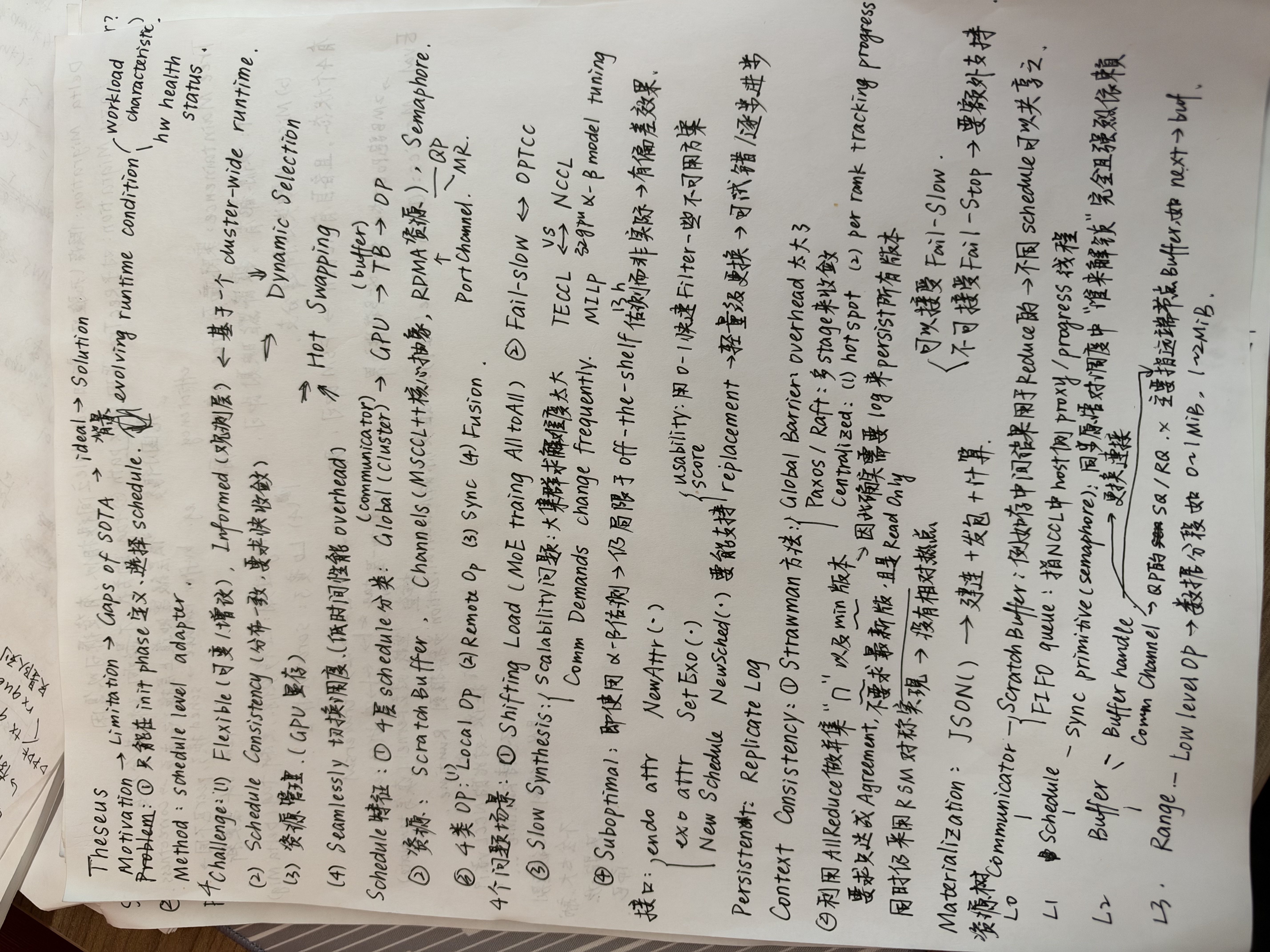
Motivation 与 Method
Motivation → Limitation → Gaps of SOTA → ideal → Solution;
只能在 init phase 定义, 选择 schedule, 而 runtime condition 在 evolving:
- workload characteristic;
- hw health status;
Method: schedule level adapter;
4 个 Challenge
- Flexible (可变 / 增改), Informed (观测层): 基于一个 cluster-wide runtime;
- Schedule Consistency: 分布一致, 要求快收敛;
- 资源管理: GPU 显存;
- Seamlessly 切换调度: 低时间性能 overhead;
前两个对应 Dynamic Selection, 后两个对应 Hot Swapping;
Schedule 特征
4 层 schedule 分类
Global (Cluster) → GPU → TB → OP;
原稿在 Global 上标了 communicator, 在 TB 上标了 buffer;
资源与 OP
- Scratch Buffer;
- Channels: MSCCL++ 核心抽象, RDMA 资源; PortChannel 旁标了 QP, MR;
- Semaphore;
4 类 OP: Local OP, Remote OP, Sync, Fusion;
4 个问题场景
- Shifting Load: MoE training AlltoAll;
- Fail-slow ↔ OptCC;
- Slow Synthesis:
- Scalability 问题: 大集群求解复杂度太大;
- Comm Demands change frequently;
- Suboptimal: 即使用 α-β 估测, 仍局限于 off-the-shelf 估测而非实际, 有偏差效果;
旁注: TECCL vs NCCL, 32 GPU; MILP vs α-β model tuning; 13 h;
接口
| 接口 | 原稿写法 |
|---|---|
| endo attr | NewAttr(·) |
| exo attr | SetExo(·) |
| New Schedule | NewSched(·) |
New Schedule 要能支持:
- usability: 用 0-1 快速 Filter 一些不可用方案;
- score;
- replacement: 轻量级更换 → 可试错 / 逐步进步;
Persistent: Replicate Log;
Context Consistency
Strawman 方法
- Global Barrier: overhead 太大了;
- Paxos / Raft: 多 stage 来收敛;
- Centralized: hotspot, per rank tracking progress;
AllReduce 与 Agreement
利用 AllReduce 做集合操作 (原稿写 “并集”, 符号记为 ), 以及 min 版本;
要求只达成 Agreement, 不要求最新版, 且是 Read Only. 因此确实需要 log 来 persist 所有版本;
同时仍采用 RSM 对称实现 → 没有相对热点;
- 可以接受 Fail-Slow;
- 不可接受 Fail-Stop → 要额外支持;
Materialization 与资源树
Materialization: JSON() → 建连 + 发包 + 计算;
资源树: L0 Communicator → L1 Schedule → L2 Buffer → L3 Range;
| 层级 | 资源与原稿说明 |
|---|---|
| L0 Communicator | Scratch Buffer: 例如存中间结果用于 Reduce 的, 不同 schedule 可以共享之; FIFO queue: 指 NCCL 中 host 侧 proxy / progress 线程; |
| L1 Schedule | Sync primitive (semaphore): 同步原语对调度中 “谁来解锁” 完全且强烈依赖; |
| L2 Buffer | Buffer handle; Comm Channel: 主要指远端节点 Buffer, 如 next->buf; 更换连接; |
| L3 Range | Low level OP: 数据分段, 如 0-1 MiB, 1-2 MiB; |
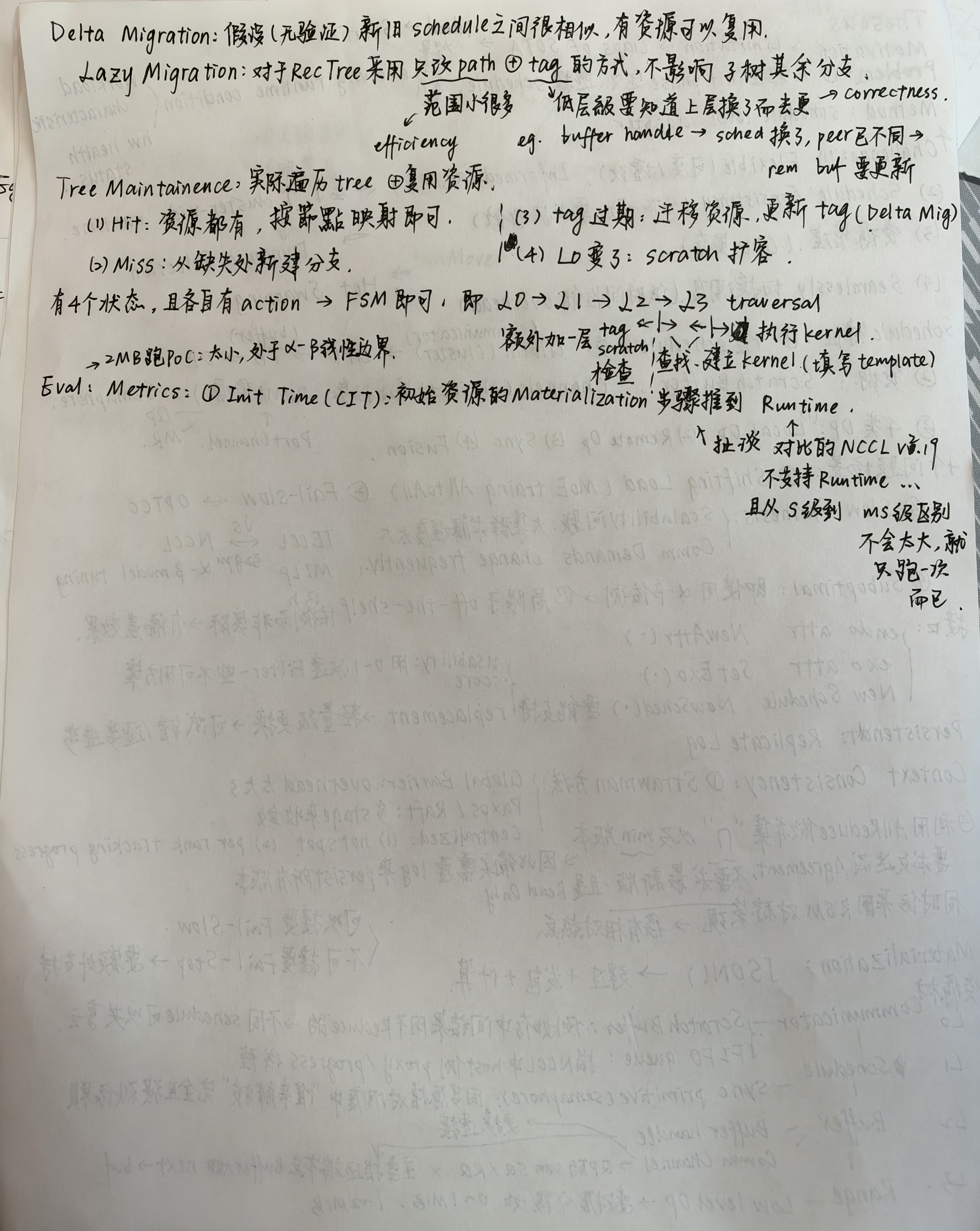
Delta Migration 与 Lazy Migration
Delta Migration: 假设 (无验证) 新旧 schedule 之间很相似, 有资源可以复用;
Lazy Migration: 对于 RecTree 采用只改 path + tag 的方式, 不影响子树其余分支;
- path: 范围小很多 → efficiency;
- tag: 低层级要知道上层换了而去更新 → correctness;
例如 buffer handle: schedule 换了, peer 已不同 → remote buffer 要更新;
Tree Maintenance
实际遍历 tree + 复用资源;
| 状态 | action |
|---|---|
| Hit | 资源都有, 按节点映射即可; |
| Miss | 从缺失处新建分支; |
| tag 过期 | 迁移资源, 更新 tag (Delta Migration); |
| L0 变了 | scratch 扩容; |
有 4 个状态, 且各自有 action → FSM 即可, 即 L0 → L1 → L2 → L3 traversal;
额外加一层 tag / scratch 检查 → 查找, 建立 kernel (填写 template) → 执行 kernel;
Eval
2 MB 跑 PoC: 太小, 处于 α-β 性能边界;
Metrics: Init Time (IT), 初始资源的 Materialization 步骤推到 Runtime;
旁注: 对比的 NCCL v2.19 不支持 Runtime 扩张, 且从 s 级到 ms 级区别不会太大, 就只跑一次而已;
手写原稿扫描版
第 1 页
第 2 页